
You Are No Wizard
Visual appraisal is step one. But it was never supposed to be the whole job.
Everybody in this business knows the guy. He walks into a pen, gets quiet, points at one heifer out of forty, and says, “That’s the one.” No scales, no paper, no performance or DNA test. Just a look. And everyone else in the pen goes quiet, almost in bewilderment, like something holy just happened.
Then the same guy’s sale catalog comes out with almost no data in it, because numbers are for people who cannot “see” cattle and just crunch performance figures, you know, like the “computer cowboys.” His cattle do not need EPDs, you know, those Expected Progeny Difference numbers that predict how an animal’s calves will perform comparatively. This is all because he has a superior eye and is a gifted breeder. And since he has been at it 30 years and his cattle sell really well, a whole lot of good people take that as proof.
I want to be careful here, because I am not going to call that man a complete fraud. Most of the time he is not. He is usually a good stockman with real skill built over a real lifetime, and I have learned things from men exactly like him that no database ever taught me.
But he is no wizard. And if you go back and read the story, neither was Dorothy’s wizard.
The man in Oz was not evil. He was a decent enough dude from Kansas, running a machine behind a curtain and doing the best he could with what he had. Everyone who wanted to see him went looking for magic and instead found a man with limited equipment. And his whole operation ran on one condition: nobody gets to look behind the curtain and check.
That is the part we’re talking about in this post. Not whether the stockman’s eye is real, because it is. The question is why a man would still be defending his “curtain” in 2026, when the tools finally exist to show people what is actually back there.
Credit where credit is due: the eye still counts
Let’s get this out of the way, because I am not interested in another version of the old argument where a geneticist tells cattlemen their judgment does not matter. It does.
When visually sorting cattle on the hoof, your eye is doing real work that no test on the market does. Feet and leg structure. Udder quality and teat size. Sheath. Disposition. Body capacity and depth of rib. Whether a female is actually fleshing on your grass or shedding all that fat that she gained due to a full feed bucket or ten. Whether that yearling bull is going to hold together for four breeding seasons or fall apart in his first.
Some of those traits have EPDs behind them now, and the good ones keep getting better. Most still do not. That is not a knock on genetic evaluation being behind. That is just where the science currently sits. Which means the man who can walk a pen and read structure is not obsolete, and he is not going to be.
So visual appraisal is foundational. Nobody serious argues otherwise. It is step one.
Step one. Not the whole staircase.
What the eye has never once seen
Here is the honest limit, and it is not a small one.
Stand a dozen like-aged haltered heifers in front of the best cattleman in the country at a venue in northern Kentucky in mid-November when they are at 12 to 14 months of age. On that day he is looking at fat, hair, age, and someone’s ability to feed. He is looking at them on their single most flattering, least informative day of their lives.
But he cannot see and evaluate their age at puberty. He cannot see their antral follicle count, an ultrasound reading of how many eggs she is carrying in reserve, which tells you a good deal about their fertility and how long they will last in the herd. He cannot see whether they breed back as a two year old, which is where most of them wash out. He cannot see their mature weight at six, or how much they eat to maintain it, or whether their daughters will still be earning their keep in 2038.
And they cannot show him the one thing that decides it all: whether they stay in the herd. Research out of USDA’s Meat Animal Research Center found that heifers who conceived in the first twenty one days of their first breeding season stayed in the herd longer and weaned more total pounds of calf over their lifetime than the ones who bred late. Longevity and fertility (Stayability) are what make or break a cow herd. They are also some of the hardest traits to predict, and they do not show their hand until years after you were forced to make the yearling cull decision.
That is not an insult to anybody’s eye. That is biology. No amount of stockmanship gets you around the fact that the trait shows up at age six and the decision is due at year one.
At BSG, that is exactly why we run Studer’s Taylor Made 7Y hard through our AI guns every year, instead of leaving his genetics alone the way we did the first time we saw him on the Shorthorn University tour all those years ago. He was on display standing at the side of his dam at Studer’s Shorthorns in Creston, Iowa. Stout. Powerful. Massive. And I knew his sire well enough to know what was coming. Nothing about that young stud said calving ease. His sire and dam both carried Birth Weight EPDs (BW) in the bottom 5-10% of the breed. Twelve years, a pasture full of daughters, and enough performance data later, his Calving Ease Direct EPD (CED) landed in the Top 10% of the breed, at a pretty high accuracy. The eye that got it right was the one reading the paper after the calves hit the ground. Not the one that looked at the bull calf and dismissed him right away.
Subjective selection was yesteryear because that was all we had
Here is what gets left out when somebody tells you the old ways were better. The old ways were not a philosophy. They were a limitation.
For the first half of the twentieth century, American cattle selection ran on pedigree and appearance, full stop. Formal livestock evaluation grew up around the big stock shows, the Chicago International opened its doors in 1900, and the herdbook was the whole data system there was. Not because our grandfathers preferred guessing. Because nobody had built anything better yet.
The minute somebody did build something better, the good stockmen went and got it.
A little history: Performance recording started at the USDA research station in Miles City, Montana back in the 1930s, with results published in the early 1940s. State beef improvement associations organized through the 1950s. Then the Beef Improvement Federation (BIF), the group that still sets the rules for how we measure cattle today, formed on February 1, 1968, with a mission that could not have been stated any plainer: move this industry off visual appraisal and onto measured performance.
Consider the two men that founded BIF, Ferry Carpenter and Frank Baker. Those were not lab men who had never sat a horse. Those were cattlemen who could see cattle as well as anybody alive, and they are the ones who said the eye alone was not good enough. The performance movement in this country was not forced on stockmen by scientists in white coats. It was started by stockmen who were honest about what they could not see.
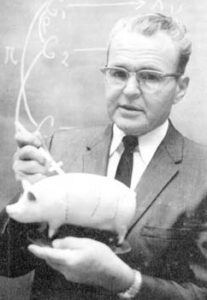
In 1972, a statistician named Henderson worked out a math model that let breeders compare animals fairly, even when those animals were raised in different herds, on different feed, in different years. That model, called BLUP, is still the engine running under every EPD printed today. The American Simmental Association put out the first beef breed sire summary in 1971. By 1980, most breed evaluations had moved from raw predicted values to what we now call EPDs, and by the end of that decade, every major breed had a sire summary of its own. The whole menu back then was four numbers: birth weight, weaning weight, yearling weight, and milk.
The 1980s and 1990s added tools you can run an animal through the chute for. Pelvic measuring came out of work in Nebraska and Montana. Reproductive tract scoring, a vet exam that grades a heifer’s reproductive tract on a one to five scale to predict how early she will cycle, came out of Colorado State in 1991. In that study, heifers scoring a five bred 64.6 percent to a single fixed time AI service, while heifers scoring a two or below bred just 40.7 percent. Missouri built the whole package into its Show Me Select certified heifer program in 1996, and has run roughly 150,000 heifers through it since.
The 2000s gave us economic selection $Indexes, and there is nothing exotic about those either. A great Iowa State geneticist named Lanoy Hazel wrote the foundational paper back in 1943, and even then he pointed out that a yardstick for net merit is about as old as animal breeding itself. An index just takes several EPDs and boils them down into one number that estimates profit for a specific goal, whether that is raising replacement females or finishing calves for the rail. An index is an EPD for profit. Nothing more.
Then the cattle genome was sequenced in 2009, and here we are.
Every single one of those steps was somebody looking behind the curtain on purpose.
Your eye is not the problem. Your curtain is.
The eye is fine. The trouble is that an eye makes a claim nobody can check, and sadly, some men have figured out that is a feature, not a flaw.
The stockman’s eye is a hypothesis. It says these cattle are elite. That is a fine hypothesis, and it might well be true. But stated that way, it can never be proven wrong, because there is no number attached that could ever fail, no way to check it. When his cattle work, it is proof of his gift. When they do not work, it was your management, your country, your grass, your bull battery. Never his cattle he sold you, right?
An EPD is what turns that hypothesis into something testable. So is an $Index. So is a genomic profile. They are the mechanism that turns a good stockman’s judgment from a personal talent into a portable, verifiable claim his customers can actually act on.
Which is why I have never understood the defensiveness. If your eye is as good as you say it is, modern genetic evaluation is the best news you have gotten in years, because it proves you right in public and in writing. The numbers should back you up.
The only man who needs the curtain is the one who has been guessing and getting paid like he was not!
So I have one question for any breeder who sells on his god-given, elite instinct alone.
You will guarantee that bull for a breeding season. Why won’t you put a longevity number on his daughters?
Think about what that says. You will stand behind the animal, which is the part your buyer can already see and judge for himself. You will not stand behind the genetics, which is the entire reason he drove four hours to your sale. The feet come with a warranty. The cow herd he is building for the next twelve years comes with a feeling.
The paper is not going away
There is a hope buried in the anti-EPD position that this is a fad, that the industry will come to its senses and go back to pedigree and appearance.
That could not be farther from the truth, and the fastest growth is not even happening at the breed associations.
Leachman Cattle of Colorado runs a database of more than 1.4 million animals, and pulls in data on 35,000 calves a year from over 125 herds across five countries, then sells that evaluation service to other seedstock outfits. Zoetis published a multi-breed productive longevity evaluation built on 1.35 million pedigree records and 978,000 phenotypes. Neogen’s commercial product runs on the IGS engine, short for International Genetic Solutions, the largest multi-breed evaluation in the world. Today that tool returns eighteen traits, eight indexes, breed composition, a measured heterosis score, a respiratory disease risk score, and a methane index, all on one commercial female.
Proprietary genetic evaluation is moving faster than any single breed association can move, because it is not bound by one herdbook, one rulebook, or one annual board meeting. The paper is getting longer every year, it is coming from more directions at once, and increasingly it does not even carry a breed association’s logo.
You can decline to participate. You cannot make it stop.
$28 against $4,000
Now the part that makes this urgent instead of philosophical.
On January 1, 2026, USDA counted 86.2 million cattle and calves in the United States, the smallest inventory since 1951. Beef cows came in at 27.6 million head, the lowest count since 1961 and roughly 4 million head below our 2019 peak. The 2025 calf crop was 32.9 million, the seventh straight annual decline.
Bred females are pushing $4,000. A commercial genomic test runs about $28.
Run that arithmetic honestly. You are making a $4,000 decision that will shape your herd for the next ten years, on an animal, and there is a $28 tool that tells you 18 things about her that you physically cannot see standing at the fence. And the argument for skipping it is that a man with a good eye does not need it.
That is not tradition. That is a 143-to-1 bet that your gut beats a genotype, placed in the tightest cattle market in seventy five years, on a female that will not pay you back a dime for two years…
What today’s best stockman actually looks like
He has not put his eye away. That is the part people get wrong about this argument.
He still walks the pen first. He still culls the bad feet, the bad udders, the wild ones, and the ones that will not hold flesh on his country, because that is work no test does for him, and he is better at it than any computer ever will be. Nobody is taking that away, and nobody should want to.
The difference is what happens next. He pulls the genetic resume (EPD profile) on the ones that passed his eye. He reads the $Index that matches his endpoint instead of chasing one trait at a time. He looks at the maternal numbers on the females he is keeping and the terminal numbers on the calves he is selling, and he does not get the two confused. He checks his work.
Sometimes the paper confirms what he already thought, and that is a good day, because now he can prove it to a buyer instead of just telling him. Sometimes the paper tells him the heifer he liked 8th best is the one that will still be in the herd at 8, and he keeps her too. That is not the machine overruling the man. That is the man finally getting to see what he was always guessing at.
That is the whole shift, and it is not complicated. Selection used to be subjective because it had to be. It is not 1948 anymore. It has not had to be for a long time.
Better catch up
If you have been telling people EPDs are for men who cannot see cattle, understand how that sounds in 2026. It does not sound confident. It sounds like a man who found out late, got embarrassed, and decided to make a poor principle out of it.
Fifty eight years have passed since organized performance testing started in this country. 58. The tools are cheap, they are available on any breed or breed combination you run, and your neighbor is already using them on females he bought out of the same pen you sorted from.
So catch up. Genomic test a set of heifers and see what you learn. Read one $Index definition all the way through, start to finish, and learn how to apply it to your program. From there, buy bulls with numbers that match where your calves actually go. Keep every bit of the stockmanship you have spent your life building, because you are going to need it, and then quit pretending it is the whole job.
Pull the curtain back yourself. If you are half as good as you have been telling people, there is nothing back there that can hurt you, and you will finally have something to hand a customer besides your masterful marketing ability and a firm handshake.
The curtain comes down either way. Pull it yourself and it’s confidence. Wait until someone else does it, and it’s a reckoning.
-Luke