Pedigree and Cow Families: Case Leads, Not Verdicts
An animal’s ancestry gives you a case lead. It does not hand you a verdict.
All cattlemen and women love a good pedigree.
Put the right names behind a bull and people start filling in the blanks before they have studied the animal standing in front of them. His sire was great. His maternal grandsire made tremendous females. His dam is a full sister to a donor everybody knows. By the time you reach the bottom of the registration paper, you have nearly convinced yourself the bull has to be good.
And he very well might be.
A pedigree records ancestry. That’s about it. It does not itemize which genes actually made the trip from that ancestry into a particular offspring of that mating. Every calf gets half its genetics from its sire and half from its dam, but it is not the same half every other calf out of that same mating gets. That is basically because of a biological phenomenon called the independent assortment of chromosomes, which takes place during metaphase I of meiosis in reproduction.
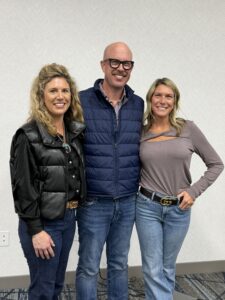
But let’s not bore you with the technical talk; I know you didn’t tune in for a biology lesson. How about this instead: Think human full siblings; this picture of my two sisters proves it better than I can explain it. Really, think about it. How often do two women, full sisters, look and act identical? Lindsay and Laura certainly do not.
Ok- back to the cattle: same sire, same dam, same names on the paper, same expected average of EPDs when they are young and without performance records. Measure them at birth and weaning then turn them out to perform for the yearling criteria, and then after that produce calves, and they can be nothing alike. One grows faster. One marbles better. One stays sound into old age. Another does not make it through her third calving season. The pedigree did not lie to you, their ancestry is identical. But if you are surprised by the results, then maybe you were only sorting the stock from an ancestry standpoint, not a genetic one.
I have observed that most Shorthorn breeders do the same thing with cow families in particular, just with a lot more sentiment attached. A strong cow family earns attention, and rightfully so. Generations of fertility, soundness, and production are not accidents, and BSG has put real dollars into breeding, cultivating and multiplying families that keep producing useful cattle year after year. But even the best cow family throws an ordinary individual every now and then. A famous female three generations back cannot fix a couple of straight hocks, replace a calf that’s that is pulled and then D.O.A., or manufacture performance nobody ever measured on the animal standing in front of you.
And here is an inconvenient truth: pedigree and cow family draw a lot of promotion, commotion, and devotion from Shorthorn breeders, especially because our breed is so maternally oriented and therefore female focused. When we think of good mama cows, people always ask for the cow families associated with the top females we speak of. And here is a fact that no one really wants to say out loud: pedigree and especially cow family are the two easiest things for a smart marketer to sell, because they are the first things a new, naive breeder latches onto. You do not need to be able to read an EPD table to be moved by a cow family name you already recognize. A cunning marketer knows exactly that, so he spends his promotional energy and advertising dollars showcasing the famous ancestors almost more than the individual he’s selling. And this is all because a cow family name people recognize closes the case before the evidence ever gets read into the record for some folks.
I know that firsthand. I bought into it “hook, line, and sinker” in my formative years as a young Shorthorn enthusiast. As a kid showing in numerous junior Shorthorn association events, and meeting many great breeders from across the country, I was obsessed with collecting females out of the popular cow families. In my mind, that was the surest path to becoming a great breeder, and I figured having those names on my pedigrees had already gotten me halfway there. It took longer than I would like to admit to realize I had been reading too much promotion and commotion and not nearly enough of the industry-oriented articles by people like Dr. Ron Bolze, wedged in between the colorful and glossy ads. The cow families were real. The value I assumed came standard with the cow family names was not.
That is the lesson: a pedigree opens a case. It does not close one. What did the sire actually transmit? What has this dam produced (not what did her mother produce two generations ago)? Does the individual’s own phenotype, EPDs, and $Indexes agree with the cow family’s reputation, or is the reputation doing all the work by itself?
Modern genetic evaluation exists to answer exactly that. A young, untested calf’s EPDs lean heavily on pedigree (the EPD average of the two parents) simply because that is the only information available at that juncture. As its own performance records (birthweight, weaning weight, yearling weight, ultrasound scan data, etc.), genomic test, and progeny data accumulate, the evaluation (EPDs) shifts toward what the animal actually IS, not what it was merely expected to be. That does not make pedigree irrelevant. It puts pedigree back in its proper place. One piece of evidence. Not the verdict.
Case Study: Studer’s Taylor Made 7Y
BSG was fortunate enough several years back to invest in 1/4 semen interest in Studer’s Taylor Made 7Y, from Leveldale Farms, and it has been nothing but prosperous for our herd in east central Indiana. We have AI bred many of our yearling heifers to him for more than 10 years now because the results are hard to argue with. Calves come early, labor is minimal, and survival to weaning runs about as good as anything going. If you only read his pedigree though, none of that would make sense, and you sure wouldn’t breed your heifers that way.
His sire, Saskvalley Ramrod 155R, carries a Birth Weight EPD (BW) of +5.0, ranked in the bottom 5% of active sires. His dam, DSF Country Dancer 42U, sits at +4.0 for BW, ranked in the bottom 10% of all active dams. On paper, that is a mating built to throw a big calf that takes some pulling. Nothing in the ancestry hints at calving ease.
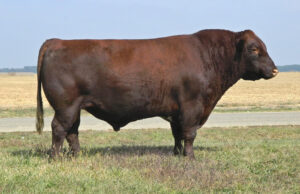
But Taylor Made’s own proven, high accuracy numbers tell a different story. His BW EPD lands at -0.6 with a 0.84 EPD Accuracy (or 84% reliability), better than three quarters of the active sires in the breed today, and his Calving Ease Direct EPD (CED) of +22 puts him in the Top 10% of the breed. The $CEZ index, which prices out calving ease specifically, backs that up: Taylor Made scores $73.85, ranked in the Top 15%. Yet Ramrod scores $29.19 and Country Dancer scores $28.74, both stuck in the bottom 10%. Taylor Made’s $Cow Productivity Index ($CPI), the broader $index that rolls the whole productive lifecycle (except carcass) into one profit number, runs $202.45, Top 5% in the breed and more than $50 clear of either parent.
Nobody could have read that pedigree when he was a yearling and called him a heifer bull. Sire and dam both point the opposite direction. But somewhere in that cross, the right half of each parent found the other, and the resulting calf, old Taylor Made, told the truth the pedigree estimates never could.
—–
So to wrap this up, start with the pedigree. Use it to decide which individuals deserve a closer look. Then do the work. Study soundness and design, check the dam’s own production, compare contemporary group performance, and let genomically enhanced EPDs and $Indexes tell you whether this animal inherited the useful half of that famous cow family, or the other half.
So here is what I want you to do next time a name on the registration paper attempts to make your decision for you: Ask what the individual has actually done, not who its ancestors were. A pedigree is a case lead. Investigate it, respect the evidence behind it, and do not let anyone, including yourself, mistake it for a verdict.
-Luke